Studio
Open it: Studio · under Settings in the console menu, or Open in Studio / Edit in Studio on any agent, template, trigger, canvas or resource.
Studio is where you write flows: a series of steps, in CNCF Serverless Workflow YAML. New to either? Read How to read and write YAML and The CNCF Workflow DSL, explained. A flow can run on its own, be started by a trigger, be called by another flow, or run inside an agent’s turn as a hook. Templates, triggers and canvases are edited here too.
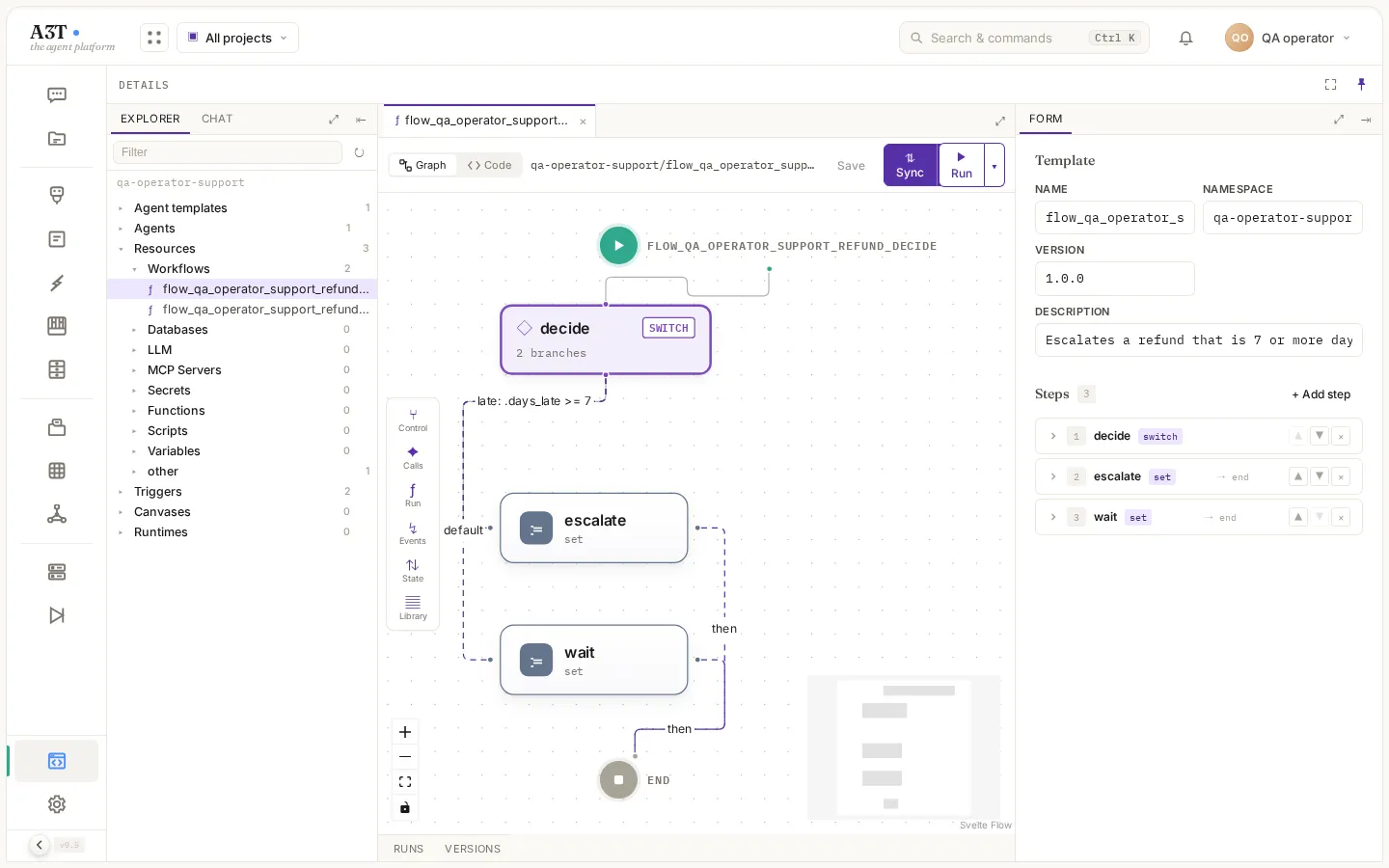
| Area | What it is |
|---|---|
| Explorer | The project’s agent templates, agents, resources (flows, databases, models, MCP servers, secrets…), triggers, canvases and runtimes. New in … starts one. Chat beside it talks to the A3T assistant about what is open |
| Editor | The open item, as a Graph or as Code (YAML). Both edit the same flow |
| Palette | Steps to add, by kind: Control (switch, for, fork, try), Calls (LLM, MCP, HTTP, ADB, agent), Run (another flow), Events, State, Library |
| Form | The flow’s name, namespace, version and description, and its steps in order: add, move, remove |
| Save | Saves the flow as its version. Sync reloads it from the server |
| Run | Runs it; Run with inputs asks for its input first |
| Runs, Versions | Its recent runs, each opening in Executions; its versions |
Write a flow
Section titled “Write a flow”The example decides what to do about a late refund: escalate one that is 7 or more days late, otherwise ask the customer to wait.
document: dsl: 1.0.3 namespace: qa-operator-support # the project it belongs to name: flow_qa_operator_support_refund_decide version: 1.0.0 title: Decide what to do about a late refundinput: schema: # what it must be started with format: json document: type: object required: [order_id, days_late] properties: order_id: { type: string } days_late: { type: integer }do: - decide: switch: - late: when: ${ .days_late >= 7 } then: escalate - default: then: wait - escalate: set: order_id: ${ .order_id } action: escalate note: ${ "Order " + .order_id + " is " + (.days_late | tostring) + " days late; hand it to a person." } then: end - wait: set: order_id: ${ .order_id } action: wait note: ${ "Order " + .order_id + " is within the normal window; ask the customer to wait." } then: endRun with inputs {"order_id": "A-1042", "days_late": 10} gives:
{ "order_id": "A-1042", "action": "escalate", "note": "Order A-1042 is 10 days late; hand it to a person." }and {"order_id": "A-1042", "days_late": 3} gives "action": "wait".
| Rule | Why |
|---|---|
Name it flow_<project>_<what it does> | So it is found and understood anywhere it is used |
| Declare its input schema | Callers, and Run with inputs, see what it needs |
| A released version never changes | Saving the same version with other content is refused (version_exists); give it the next version. Runs and agents can stay on the version they use |
| Every step is checked as it runs | A call is a policy decision, as the person the run is for; see Security |
Hook a flow into an agent
Section titled “Hook a flow into an agent”A hook is a flow of yours that runs at a fixed point in every turn of an agent, as the caller. Attach hooks on the agent’s Build › Hooks: pick a flow for a phase and click Attach (or New hook flow to start one from a ready-made skeleton), then Save. Several hooks on one phase run in the order listed; ↑ and ↓ reorder them.
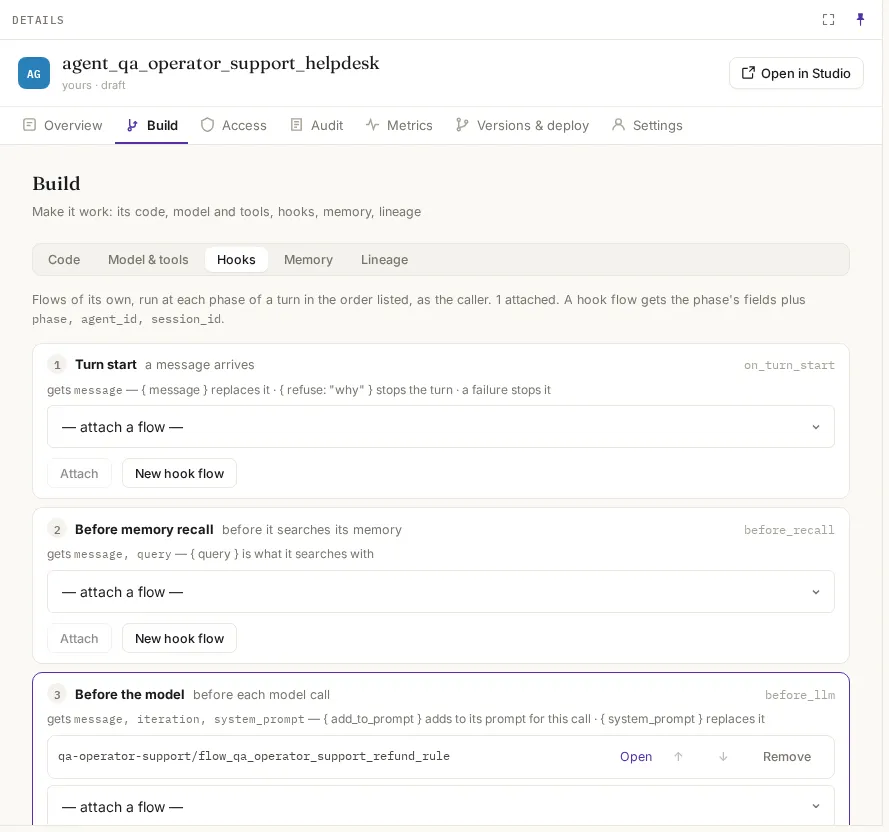
| Phase | Runs | Gets | What it can return |
|---|---|---|---|
on_turn_start | When a message arrives | message | { message } replaces it; { refuse: "why" } stops the turn |
before_recall | Before it searches its memory | message, query | { query }: what it searches with |
before_llm | Before each model call | message, iteration, system_prompt | { add_to_prompt } adds to the prompt for this call; { system_prompt } replaces it |
after_llm | After each model call | iteration, content, tool_calls | Observes only: the text has already streamed |
on_tool_call | Before each tool call | tool, input | { input } replaces the arguments; { refuse: "why" } blocks it, and the model is told |
after_tool_call | After each tool call | tool, input, output | { output }: what the model sees, e.g. redacted |
on_tool_error | A tool call failed | tool, input, error | { output } is used in place of the error |
before_store | Before the turn is remembered | message, reply | { reply }: what is remembered; { skip: true } remembers nothing |
on_turn_end | The caller has its answer | message, reply, tool_calls, iterations, outcome | Observes only: log, notify, check |
A hook that fails at on_turn_start stops the turn; one that fails at on_tool_call blocks that call.
Example: a refund rule before every model call
Section titled “Example: a refund rule before every model call”document: dsl: 1.0.3 namespace: qa-operator-support name: flow_qa_operator_support_refund_rule version: 1.0.0 title: Refund rule for the help-desk agentdo: - add_rule: set: add_to_prompt: Refunds not received 7 or more days after approval are escalated to a person; never promise a date.Attached to the help-desk agent at before_llm, it changes its answers at once. Asked “Order B-2210: my refund was approved 10 days ago and still has not arrived. When will I get it?”, the agent answered:
Since it’s been 10 days since approval — which is past the 7-day threshold — this needs to be escalated to a person on our team who can investigate and resolve it directly. I can’t promise a specific date, but let me hand this over now…