Knowledge
Open it: Knowledge · under Knowledge & data in the console menu.
A knowledge graph is a map of things (agents, models, tools, organisations…) and how they are linked, built from facts: subject → predicate → object entries in a semantic space in ADB. A3T stores the graph’s triples and trains RotatE embeddings on them, so it can also suggest links that are likely but missing.
Each graph has four tabs.
Overview
Section titled “Overview”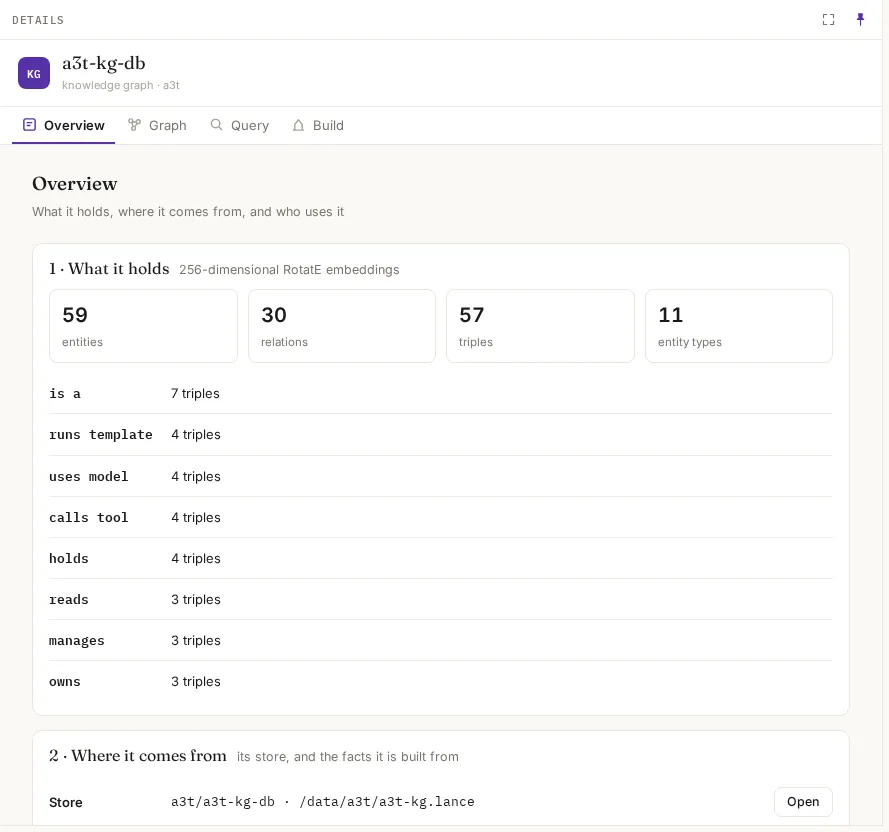
| Section | What it shows |
|---|---|
| What it holds | Counts of entities, relations, triples and entity types; the most used relations; the embedding size |
| Where it comes from | Its store and the semantic space it was built from |
| Used by | The agents, flows, canvases and triggers that name it |
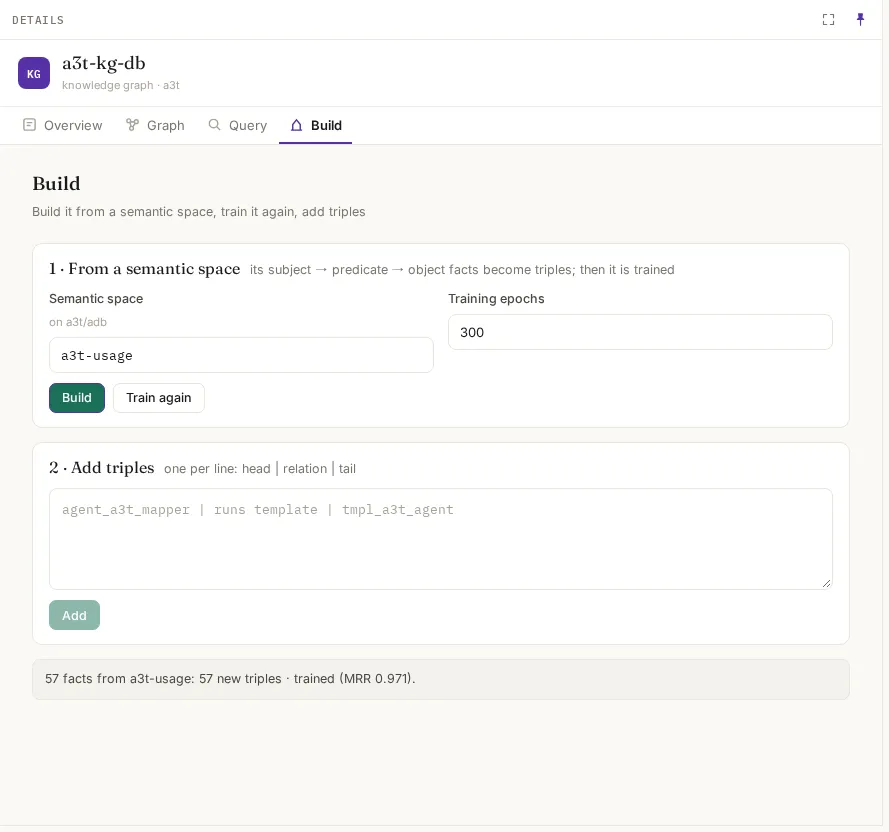
| Section | What it does |
|---|---|
| From a semantic space | Pick a semantic space in ADB and the training epochs, then Build: every subject → predicate → object fact becomes a triple, and the embeddings are trained. Train again retrains on what it holds |
| Add triples | One per line, head | relation | tail |
Building a3t-kg-db from the a3t-usage space gave: 57 facts from a3t-usage: 57 new triples · trained (MRR 0.971). MRR (mean reciprocal rank) measures how well the embeddings rank the true links; 1.0 is perfect.
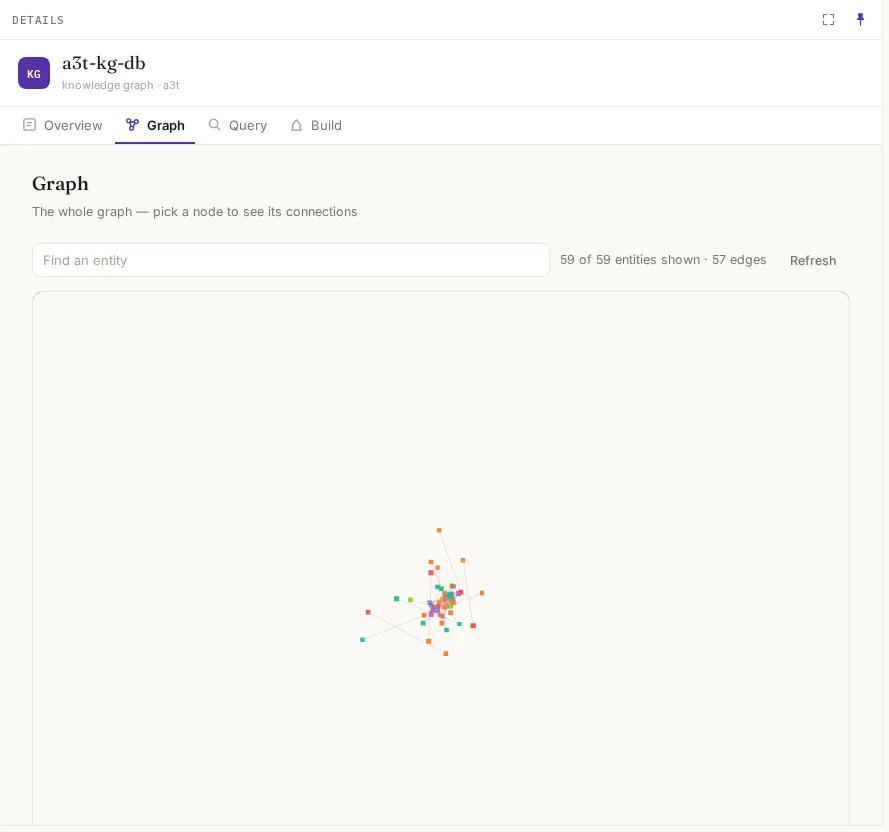
Every entity is a point, placed by its embedding (related things sit close together) and coloured by its type. Find an entity jumps to it; pick a point to see its connections.
| Section | What it does |
|---|---|
| Triples | Find triples by head, relation and tail; leave any empty. E.g. relation uses model lists which agent uses which model |
| Predict | The likeliest tails for a head and a relation, from the embeddings: a link that is probably true but not yet stated |
| AQL on its source | Read the facts it was built from, in ADB (RECALL only) |
Agents and knowledge
Section titled “Agents and knowledge”An agent reads shared knowledge from the semantic spaces attached to it (agent Build › Memory). The graph is built from the same facts; rebuild it after the facts change.